Paint Correction Explained: Compounding, Polishing, Jeweling, and What to Expect
Paint correction is one of the most effective ways to restore gloss, clarity, and depth to a vehicle's finish. Whether you're considering a one-step polish or a multi-stage correction, understanding the process helps set realistic expectations and ensures you choose the right service for your vehicle.
In Dallas, vehicles are constantly exposed to intense UV rays, hard water, pollen, airborne dust, and improper washing techniques, all of which contribute to swirl marks, oxidation, and paint defects.
What Is Paint Correction?
Paint correction is the process of removing or reducing imperfections in a vehicle's clear coat through machine polishing.
Unlike waxes or fillers that temporarily hide defects, paint correction physically levels a microscopic amount of clear coat to improve the appearance of the paint.
Paint correction can improve:
Swirl marks
Fine scratches
Water spot etching
Oxidation
Haze
Buffer trails
Loss of gloss
Paint correction cannot permanently repair:
Rock chips
Deep scratches that penetrate the clear coat
Peeling clear coat
Areas where paint has failed
What Is the Difference Between Compounding and Polishing?
Paint correction is commonly divided into two stages: compounding and polishing.
Compounding (Cutting)
Compounding, often referred to as cutting, is the more aggressive stage of paint correction.
A machine polisher, cutting pad, and abrasive compound work together to remove a small amount of clear coat surrounding defects. This process levels the paint and significantly reduces scratches and swirl marks.
Compounding is effective for removing:
Moderate to heavy swirl marks
Wash-induced scratching
Oxidation
Light etching
Some deeper defects
Because compounding uses larger abrasives, it can leave behind slight hazing or micro-marring, especially on softer paints.
Polishing
Polishing is the refinement stage.
Using a softer pad and finer polish, the paint is further refined to remove any haze left behind by compounding while maximizing gloss and clarity.
A properly polished finish will often appear:
Deeper
Darker
Sharper under direct lighting
More reflective
Think of compounding as sanding a piece of wood smooth and polishing as applying the final finish that brings out its richness.
What Is a One-Step Paint Correction?
A one-step paint correction combines defect removal and finishing into a single polishing stage.
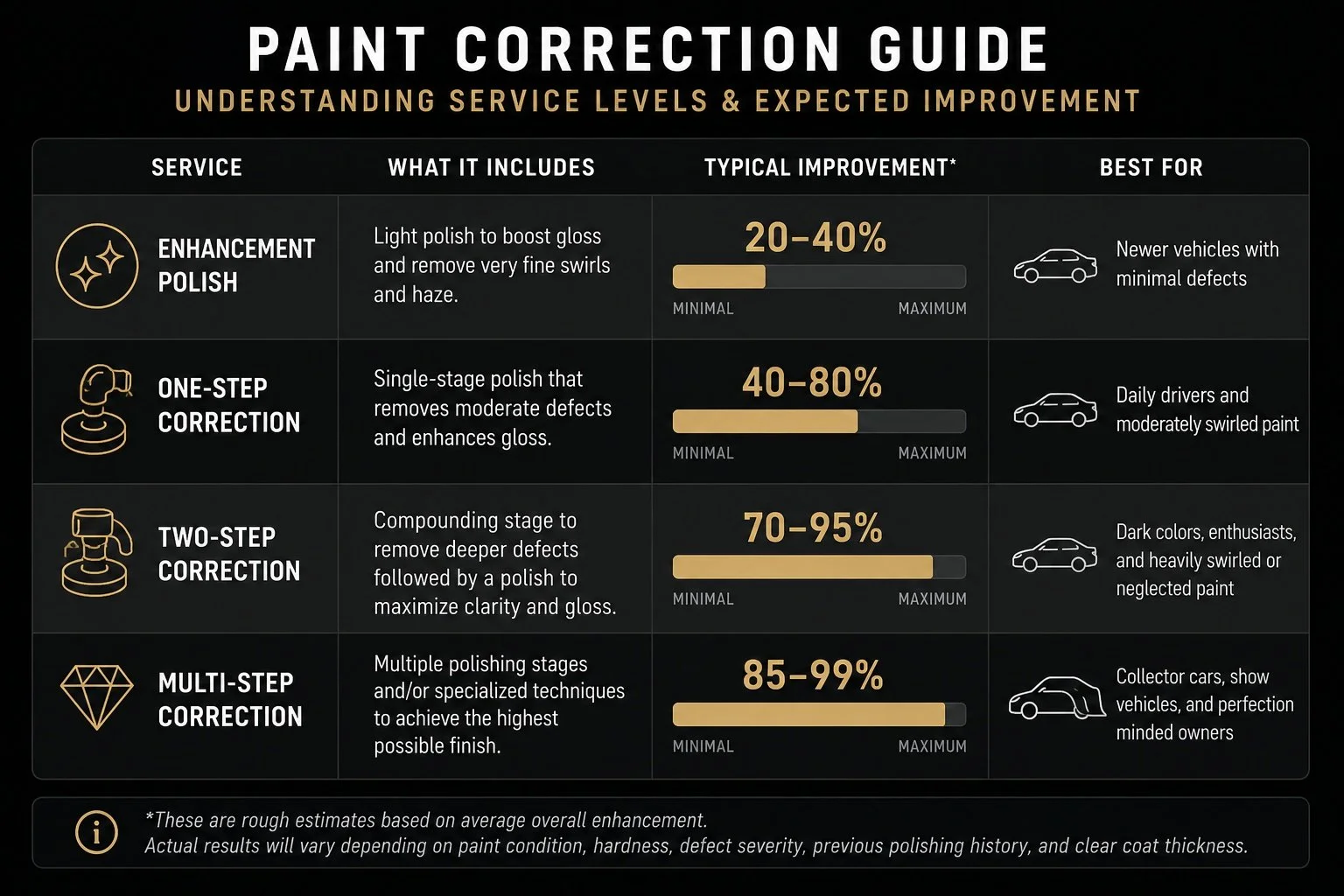
This process typically removes 50-75% of visible paint defects while producing a significant increase in gloss.
One-step corrections are ideal for:
Daily drivers
Newer vehicles
Cars with moderate swirl marks
Owners looking for the best value
For many vehicles, a one-step correction provides the greatest visual improvement for the least amount of labor.
What Is a Two-Step Paint Correction?
A two-step paint correction consists of:
A dedicated compounding stage
A dedicated polishing stage
Two-step corrections typically remove 75-95% of paint defects, depending on paint thickness, paint hardness, and defect severity.
Two-step corrections are often recommended for:
Black vehicles
Older vehicles
Enthusiast-owned cars
Vehicles that have been washed improperly for years
Although more time intensive, the improvement in gloss, depth, and clarity is usually noticeable under both sunlight and inspection lighting.
What Is a Multi-Step Paint Correction?
Some vehicles require additional refinement stages beyond a traditional two-step correction.
Multi-step corrections may include:
Spot sanding
Multiple pad combinations
Intermediate polishing stages
Ultra-fine finishing polishes
These services are typically reserved for collector cars, show cars, and owners pursuing near-perfect finishes.
What Is Jeweling in Auto Detailing?
Jeweling is the final refinement stage performed after polishing.
The goal of jeweling is not defect removal but maximizing gloss and optical clarity.
Detailers use extremely soft pads, very fine finishing polishes, and slow machine speeds to further refine the paint.
Jeweling can create a finish that appears:
More liquid
More reflective
More three-dimensional
The difference is subtle and is most noticeable on darker colors under direct lighting.
For many daily-driven vehicles, the added labor involved in jeweling may not justify the small visual gain.
How Much Defect Removal Should You Expect?
Paint correction is about improvement, not perfection.
Typical results include:
Is Paint Correction Worth It?
For many owners, paint correction offers one of the most dramatic transformations possible without repainting a vehicle.
Paint correction can:
Restore depth and gloss
Increase pride of ownership
Improve resale presentation
Enhance the appearance of ceramic coatings
Preserve the remaining clear coat when performed properly
The best paint correction service is not always the most aggressive option. It is the one that balances appearance, budget, and long-term paint preservation.
At Onyx Detail Collective, we focus on achieving the greatest possible improvement while preserving the integrity of your vehicle's finish. Whether that means removing 60% of defects in a single stage or pursuing a near-flawless finish through multiple polishing steps, our goal is to provide realistic expectations and lasting results.
